
Glossary
The Garage Coating Glossary
Plain-English meanings for mil, broadcast, dew point, polyaspartic, laitance, cove base and other words you will see on a plan or a quote.
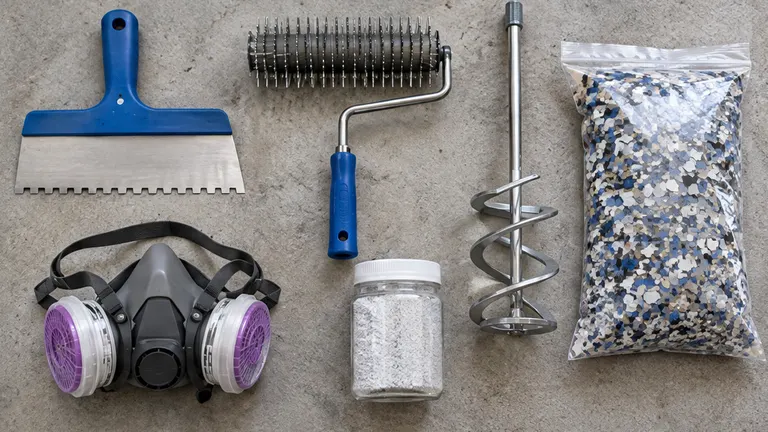
- Aggregate
- Colored quartz sand or small stones thrown into a coating for texture and grip.
- Base coat
- The first thick layer of resin that bonds to the slab and holds the flakes.
- Blushing
- A cloudy, whitish or sticky look on a coating that cured while condensation or high humidity was on the surface.
- Broadcast
- Throwing flakes or quartz by hand into a wet coat. Full broadcast covers it completely, light broadcast leaves the base showing.
- Calcium chloride test
- A test that traps a small dish of salt under a dome on the slab and weighs the water it absorbs over 24 hours.
- Cove base
- The coating curved up the wall a few inches, like a baseboard made of the floor, so there is no seam.
- Cure
- The time a coating needs to harden. It depends on the product, the temperature and the humidity.
- Densifier
- A liquid that soaks into concrete and hardens the top layer. It leaves no thick film.
- Dew point
- The temperature at which air starts to drop its moisture as water. A slab close to it can sweat.
- Diamond grinding
- Cutting the top of the slab with diamond tooling to open the surface so a coating can grip it.
- Efflorescence
- A white, chalky powder left on concrete when moisture carries salts to the surface.
- Epoxy
- A two-part resin that bonds well and builds a thick, hard film. It can yellow in strong sun.
- Flake
- Colored vinyl chips mixed into or thrown on a coating for a speckled look that hides dust and marks.
- Hot tire pickup
- When hot tires soften a weak coating and lift it in the tire lanes.
- Laitance
- A weak, powdery layer on the top of a concrete slab that has to be ground off.
- Metallic epoxy
- Epoxy mixed with pearl pigments and worked into swirls that look like liquid marble.
- Mil
- One thousandth of an inch. A credit card is about 30 mils thick.
- Moisture vapor
- Water in gas form that rises through a concrete slab and can lift a coating from underneath.
- Mortar patch
- A repair material used to fill pits and broken edges before a coating.
- Pot life
- How long mixed resin stays workable in the bucket before it starts to set.
- Polyaspartic
- A fast-curing, UV-stable resin often used as a clear topcoat or a quick base.
- Polyurea
- A flexible, fast-setting resin that stands up to abrasion and moves a little with the slab.
- Primer
- A thin first layer, often moisture-tolerant, that helps the base coat bond.
- Profile
- How rough the prepared concrete is. Coatings are matched to a profile, measured on a scale from one to ten.
- Quartz floor
- A floor made by broadcasting colored quartz sand into resin and sealing it. Very hard and grippy.
- Relative humidity
- How much water the air holds as a percent of the most it could hold at that temperature.
- Shot blasting
- Throwing steel shot at a slab and collecting it again to clean and texture the surface.
- Slip resistance
- How much grip a floor has, especially when wet. Fine grit in the topcoat increases it.
- Squeegee
- A rubber-bladed tool used to spread and level coatings and to clear water.
- Topcoat
- The clear top layer that takes the wear and sets the sheen.
- UV stable
- Does not turn yellow or cloudy in sunlight.
- Urethane cement
- A thick, heat-tolerant, damp-tolerant floor used in wash bays and kitchens.
- Wet film thickness
- How thick a coating is while it is still wet, measured with a notched gauge.
Still have a question?
Ask us. We are happy to explain anything on a plan or a quote.